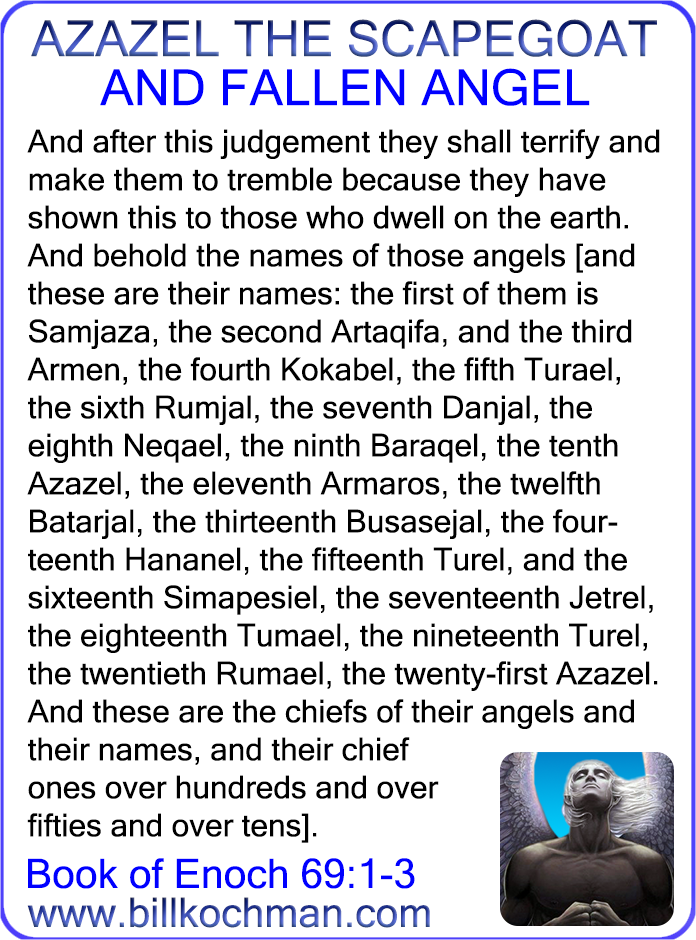
In the original Hebrew, the English word scapegoat is “azazel”. Please refer to the article entitled “Azazel: Scapegoat of the High Priest” for more details regarding this topic.
“Azazel the Scapegoat and Fallen Angel” KJV Bible Verse List:
“. . . behold, ye have sinned against the LORD: and be sure your sin will find you out.” Numbers 32:23b, KJV
“For his eyes are upon the ways of man, and he seeth all his goings.” Job 34:21, KJV
“For I acknowledge my transgressions: and my sin is ever before me.” Psalm 51:3, KJV
“O God, thou knowest my foolishness; and my sins are not hid from thee.” Psalm 69:5, KJV
“Thou hast set our iniquities before thee, our secret sins in the light of thy countenance.” Psalm 90:8, KJV
“The eyes of the LORD are in every place, beholding the evil and the good.” Proverbs 15:3, KJV
“Can any hide himself in secret places that I shall not see him? saith the LORD. Do not I fill heaven and earth? saith the LORD.” Jeremiah 23:24, KJV
“He revealeth the deep and secret things: he knoweth what is in the darkness, and the light dwelleth with him.” Daniel 2:22, KJV
“. . . Is a candle brought to be put under a bushel, or under a bed? and not to be set on a candlestick? For there is nothing hid, which shall not be manifested; neither was any thing kept secret, but that it should come abroad.” Mark 4:21b-22, KJV
“For there is nothing covered, that shall not be revealed; neither hid, that shall not be known.” Luke 12:2, KJV
“If I had not come and spoken unto them, they had not had sin: but now they have no cloke for their sin.” John 15:22, KJV
“Neither is there any creature that is not manifest in his sight: but all things are naked and opened unto the eyes of him with whom we have to do.” Hebrews 4:13, KJV
“But why dost thou judge thy brother? or why dost thou set at nought thy brother? for we shall all stand before the judgment seat of Christ. For it is written, As I live, saith the Lord, every knee shall bow to me, and every tongue shall confess to God. So then every one of us shall give account of himself to God.” Romans 14:10-12, KJV
“For we must all appear before the judgment seat of Christ; that every one may receive the things done in his body, according to that he hath done, whether it be good or bad.” 2 Corinthians 5:10, KJV
“Wherein they think it strange that ye run not with them to the same excess of riot, speaking evil of you: Who shall give account to him that is ready to judge the quick and the dead.” 1 Peter 4:4-5, KJV
“And I saw a great white throne, and him that sat on it, from whose face the earth and the heaven fled away; and there was found no place for them. And I saw the dead, small and great, stand before God; and the books were opened: and another book was opened, which is the book of life: and the dead were judged out of those things which were written in the books, according to their works. And the sea gave up the dead which were in it; and death and hell delivered up the dead which were in them: and they were judged every man according to their works.” Revelation 20:11-13, KJV
Lest any Futurists try to ignorantly or intentionally misinterpret this verse in the Book of Zephaniah, let me point out that the verse has absolutely nothing to do with some future return of Jesus Christ.
The prophet Zephaniah was a contemporary of Jeremiah, Daniel and some of the other minor prophets.
Just as Jeremiah began preaching as a young boy during the reign of King Josiah — and continued to preach for forty years after that — so did Zephaniah. This fact can be easily confirmed by reading the opening verses of both Books.
To reiterate, “the great day of the LORD” which is mentioned in this verse is NOT describing a future return of Jesus Christ.
In Scripture, this phrase is sometimes used to describe a time of great chastisement and destruction when God uses the enemies of Israel to mete out His judgments against a rebellious people.
In other words, God doesn’t actually come — like in the Second Coming doctrine which is embraced by many Christians — He simply intervenes via the enemies of Israel to pour out His judgments.
So, just like the prophet Jeremiah, this verse is in reality describing the coming judgment and destruction of Judah and Jerusalem by the hand of the armies of Babylonian king Nebuchadnezzar.
As I point out in my Bill’s Bible Basics articles, this event occurred during the third Babylonian siege against Jerusalem around 587 BC.
If anyone tries to explain this verse differently — such as by pushing its fulfillment into the future — they are deceived and don’t know what they are talking about. Please just ignore them.
“And if any man think that he knoweth any thing, he knoweth nothing yet as he ought to know.”
1 Corinthians 8:2, KJV